Deprecated: Creation of dynamic property GD_SEV_Plugin::$__FILE__ is deprecated in /var/www/wp-content/plugins/search-engine-visibility/classes/plugin.php on line 19

Deprecated: Return type of WPGMZA\CustomFeatureFields::getIterator() should either be compatible with IteratorAggregate::getIterator(): Traversable, or the #[\ReturnTypeWillChange] attribute should be used to temporarily suppress the notice in /var/www/wp-content/plugins/wp-google-maps-pro/includes/custom-fields/class.custom-map-object-fields.php on line 120

Deprecated: Return type of WPGMZA\CustomFeatureFields::jsonSerialize() should either be compatible with JsonSerializable::jsonSerialize(): mixed, or the #[\ReturnTypeWillChange] attribute should be used to temporarily suppress the notice in /var/www/wp-content/plugins/wp-google-maps-pro/includes/custom-fields/class.custom-map-object-fields.php on line 129

Deprecated: Return type of WPGMZA\CustomFeatureFields::count() should either be compatible with Countable::count(): int, or the #[\ReturnTypeWillChange] attribute should be used to temporarily suppress the notice in /var/www/wp-content/plugins/wp-google-maps-pro/includes/custom-fields/class.custom-map-object-fields.php on line 111

Deprecated: Return type of WPGMZA\CustomFields::getIterator() should either be compatible with IteratorAggregate::getIterator(): Traversable, or the #[\ReturnTypeWillChange] attribute should be used to temporarily suppress the notice in /var/www/wp-content/plugins/wp-google-maps-pro/includes/custom-fields/class.custom-fields.php on line 121

Deprecated: Return type of WPGMZA\CustomFields::jsonSerialize() should either be compatible with JsonSerializable::jsonSerialize(): mixed, or the #[\ReturnTypeWillChange] attribute should be used to temporarily suppress the notice in /var/www/wp-content/plugins/wp-google-maps-pro/includes/custom-fields/class.custom-fields.php on line 130

Deprecated: Return type of WPGMZA\CustomFields::count() should either be compatible with Countable::count(): int, or the #[\ReturnTypeWillChange] attribute should be used to temporarily suppress the notice in /var/www/wp-content/plugins/wp-google-maps-pro/includes/custom-fields/class.custom-fields.php on line 136

Deprecated: Creation of dynamic property WPGMZA\ProDatabase::$version is deprecated in /var/www/wp-content/plugins/wp-google-maps-pro/includes/class.pro-database.php on line 12

Deprecated: Creation of dynamic property WPGMZA\ProDatabase::$charset_collate is deprecated in /var/www/wp-content/plugins/wp-google-maps-pro/includes/class.pro-database.php on line 13
The Exoplanet that Vanished -

The Exoplanet that Vanished

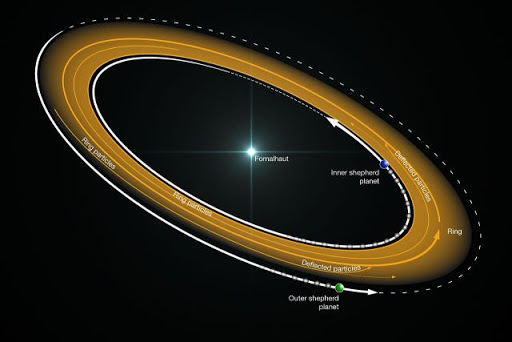
An artist's impression of the Fomalhaut system.

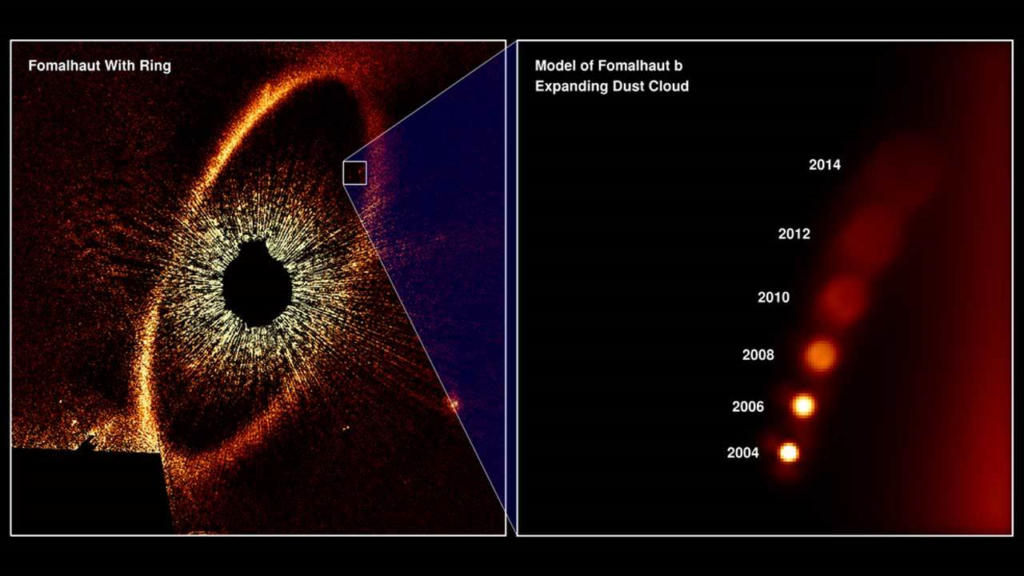
This diagram simulates what astronomers, studying Hubble Space Telescope observations, taken over several years, consider evidence for the first-ever detection of the aftermath of a titanic planetary collision in another star system. The color-tinted Hubble image on the left is of a vast ring of icy debris encircling the star Fomalhaut, located 25 light-years away.
Credits: NASA, ESA, and A. Gáspár and G. Rieke (University of Arizona)

What had been thought to be planet beyond our solar system now seems to have vanished, and astronomers are looking for a plausible explanation. One interpretation is that, rather than being a full-sized planet, it could instead be a vast, expanding cloud of dust produced in a collision between two large bodies orbiting nearby star Fomalhaut. Future, additional observations might be able to confirm this conclusion.

“These collisions are exceedingly rare and so this is a big deal that we actually get to see one,” said András Gáspár of the University of Arizona, Tucson. “We believe that we were at the right place at the right time to have witnessed such an unlikely event with NASA’s Hubble Space Telescope.”

“The Fomalhaut system is the ultimate test lab for all of our ideas about how exoplanets and star systems evolve,” added George Rieke of the University of Arizona’s Steward Observatory. “We do have evidence of such collisions in other systems, but none of this magnitude has been observed in our solar system. This is a blueprint of how planets destroy each other.”

This video simulates what astronomers, studying Hubble Space Telescope observations, consider evidence for the first-ever detection of the aftermath of a titanic planetary collision in another star system.
Credits: NASA, ESA, and A. Gáspár and G. Rieke (University of Arizona)

Read the complete article at the NASA Exoplanet website.

Social Media Auto Publish Powered By : XYZScripts.com
Share via
Copy link
Powered by Social Snap